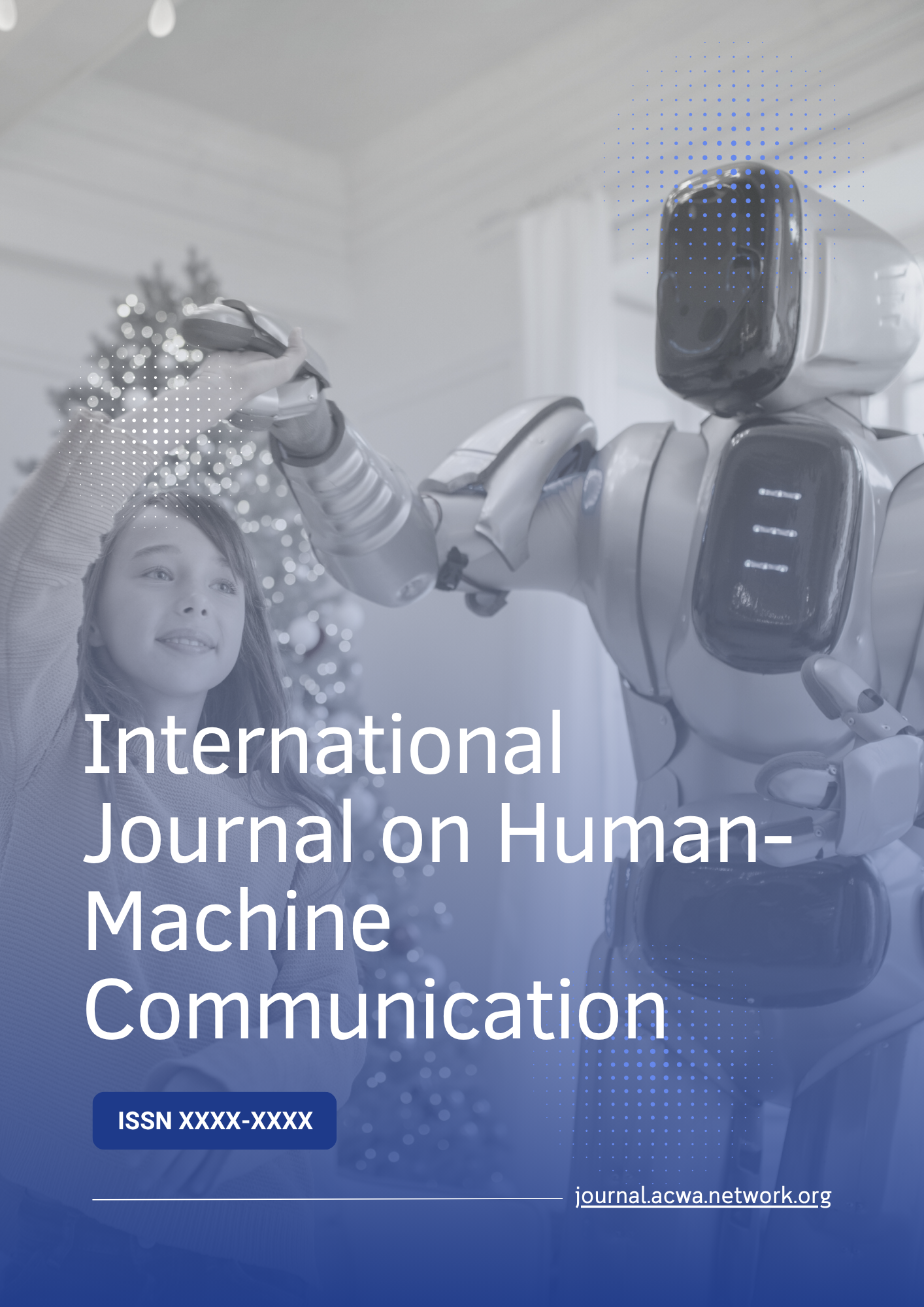

The International Journal on Human–Machine Communication accepts original scholarly manuscripts that contribute to the study of communication, interaction, and collaboration between humans and intelligent machines. Submissions may address theoretical, empirical, conceptual, design-based, or applied topics related to artificial intelligence systems, robots, conversational agents, cyber-physical technologies, and other machine-mediated communication environments.
Manuscript Types
The journal welcomes the following types of manuscripts:
-
Original research articles
-
Conceptual and theoretical articles
-
Empirical studies
-
Design and evaluation studies
-
Case studies
-
Policy and ethical analysis articles
-
Interdisciplinary studies related to human–machine communication
General Requirements
Manuscripts submitted to the journal must be original, unpublished, and not under consideration by another journal. The manuscript should be written clearly, systematically, and academically. Authors must ensure that the manuscript is free from plagiarism, data fabrication, data falsification, and unethical text reuse.
The manuscript should be written in English and follow proper academic grammar, structure, and citation standards. Authors are responsible for ensuring that all references, tables, figures, and data are accurate and properly presented.
Manuscript Structure
Manuscripts should generally include the following sections:
Title
The title should be concise, informative, and reflect the main issue of the study.
Author Information
Authors should provide full name, institutional affiliation, email address, and ORCID ID where available.
Abstract
The abstract should briefly describe the background, purpose, research design, main findings, and contribution of the study. The abstract should be written in one paragraph and should not contain citations.
Keywords
Authors should provide 3–6 keywords that represent the main focus of the manuscript.
Introduction
The introduction should explain the background of the study, research gap, problem statement, objectives, novelty, and contribution to the field of human–machine communication.
Literature Review
This section should present relevant theories, previous studies, and conceptual foundations that support the research.
Research Design and Data Analysis
This section should explain the research approach, data sources, participants or research objects, instruments, data collection procedures, and data analysis techniques. For studies involving human participants, user data, artificial intelligence systems, robots, or digital interaction records, authors should clearly state ethical approval, consent procedures, and data protection measures where applicable.
Results and Discussion
The results should be presented clearly and supported by appropriate evidence, tables, figures, or statistical analysis where relevant. The discussion should interpret the findings, relate them to previous studies and theories, and explain their scholarly or practical implications.
Conclusion
The conclusion should summarize the main findings, contribution, limitations, and possible directions for future research.
Acknowledgment
Authors may acknowledge individuals, institutions, or organizations that supported the research.
Funding Statement
Authors should disclose all sources of funding or state that no funding was received.
Conflict of Interest Statement
Authors must declare any potential conflict of interest. If there is no conflict, authors should state: “The authors declare no conflict of interest.”
References
All cited sources must be listed in the reference section. References should be accurate, complete, and consistent with the journal citation style.
Formatting Guidelines
Manuscripts should follow these formatting requirements:
-
Manuscript length: 5,000–8,000 words, including references.
-
File format: Microsoft Word document.
-
Font: Times New Roman, 12 pt.
-
Spacing: 1.5 line spacing.
-
Paper size: A4.
-
Margins: 2.5 cm on all sides.
-
Tables and figures must be numbered consecutively and titled clearly.
-
Figures must be high quality and readable.
-
Citations and references must follow APA 7th edition style.
Citation and Reference Style
The journal uses APA 7th edition citation style. Authors must ensure that every source cited in the text appears in the reference list, and every source in the reference list is cited in the manuscript.
Example in-text citation:
Human–machine communication requires attention to interaction, interpretation, trust, and social meaning in technology use (Author, Year).
Example reference format:
Author, A. A., & Author, B. B. (Year). Title of article. Title of Journal, volume(issue), page range. https://doi.org/xxxxx
Tables and Figures
Tables and figures should be placed close to the relevant text or submitted as separate files when necessary. Each table and figure must have a clear title and source information when adapted from other works. Authors must obtain permission for copyrighted materials used in the manuscript.
Ethical Requirements
Authors must follow ethical standards in conducting and reporting research. Studies involving human participants, user interaction data, digital communication records, biometric data, AI-mediated communication, robots, conversational agents, or cyber-physical technologies must respect privacy, consent, confidentiality, and responsible data use.
Authors must disclose the use of artificial intelligence tools when such tools are used substantially in writing, analysis, coding, image generation, or data processing. AI tools must not be listed as authors.
Similarity and Plagiarism Screening
All submitted manuscripts may be checked using similarity detection software. Manuscripts with excessive similarity, plagiarism, duplicate publication, or improper citation may be rejected before or during the review process.
Submission Process
Authors should submit manuscripts through the journal’s online submission system. Before submission, authors must ensure that:
-
The manuscript follows the journal template.
-
The manuscript has not been published or submitted elsewhere.
-
All author information is complete and accurate.
-
References follow APA 7th edition style.
-
Tables and figures are properly numbered and titled.
-
Ethical approval and conflict of interest statements are included where applicable.
Review Process
Submitted manuscripts will undergo editorial screening to assess relevance, originality, structure, and compliance with journal standards. Manuscripts that meet the initial requirements will be sent for peer review. The editorial decision may result in acceptance, revision, resubmission, or rejection.
Revision Policy
Authors who receive revision requests must respond to reviewer and editor comments carefully. Revised manuscripts should be submitted together with a response document explaining how each comment has been addressed.
Copyright and Licensing
Authors retain responsibility for the content of their published work. By submitting a manuscript, authors agree that the article may be published under the journal’s copyright and licensing policy. Authors must ensure that all copyrighted materials used in the manuscript have received appropriate permission.
Final Proof
Before publication, authors may receive a final proof for checking. At this stage, only minor corrections related to spelling, formatting, author information, and layout are allowed. Major changes to content are not permitted after final approval.