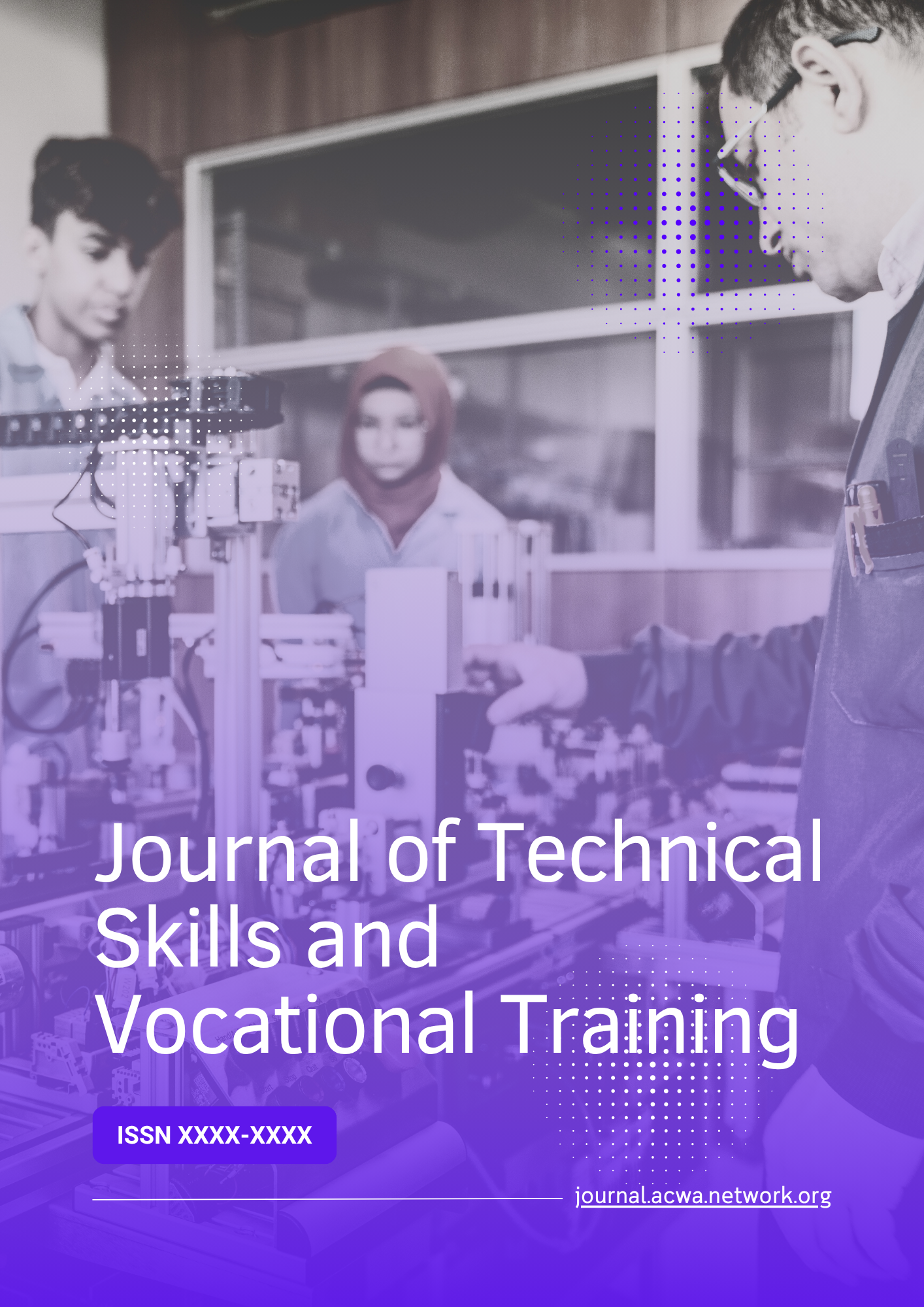
The Journal of Technical Skills and Vocational Training publishes high-quality, peer-reviewed research on the development, delivery, and assessment of technical skills within vocational and technical education and training systems. The journal focuses on how occupational skills, practical competencies, and industry-relevant technical abilities are cultivated through structured vocational training to support employability, workforce readiness, and economic development.
Types of Manuscripts
The journal accepts the following types of manuscripts:
-
Original research articles
-
Conceptual and theoretical articles
-
Empirical studies
-
Case studies on technical skills training
-
Policy analysis and recommendations
-
Technological advancements in vocational education
-
Evaluation studies of vocational training programs
-
Innovation in teaching and learning methodologies
-
Reviews of literature on vocational education and training
-
Studies on industry partnerships and workforce development
General Requirements
Submitted manuscripts must be:
-
Original, unpublished work that is not under consideration by another journal or publication outlet.
-
Written in clear academic English and formatted according to the journal's guidelines.
-
Relevant to the development of technical skills, vocational education, and workforce readiness in the context of training systems and industries.
Authors must ensure that the manuscript is free from plagiarism, duplicate publication, data fabrication, or falsification. Proper citation of all sources, including academic literature, training materials, industry reports, and other data sources, is required.
Manuscript Structure
The manuscript should generally follow this structure:
Title
The title should be concise, informative, and clearly reflect the focus of the study.
Author Information
Authors must provide full name, institutional affiliation, email address, and ORCID ID (if available).
Abstract
The abstract should summarize the study’s background, objectives, research approach, key findings, and contributions. The abstract must be one paragraph and should not contain citations.
Keywords
Authors should provide 3–6 keywords relevant to the manuscript's focus.
Introduction
The introduction should outline the research problem, objectives, rationale, and relevance to vocational training and technical skills development.
Literature Review
This section should provide an overview of relevant theories, concepts, and prior studies related to vocational education, training systems, and workforce readiness.
Research Design and Methods
This section should describe the research approach, data sources, sample size, data collection methods, tools or instruments used, and data analysis techniques. Ethical considerations related to human participants, industry data, or training systems should also be discussed.
Results
Results should be clearly presented, supported by data, tables, figures, or other visual aids. Any statistical analyses or key findings should be highlighted.
Discussion
The discussion should interpret the findings, relate them to previous research, and explain their implications for vocational training practices, policy, or industry standards.
Conclusion
The conclusion should summarize the main findings, limitations of the study, contributions to the field, and recommendations for future research or practical application.
Acknowledgments
Authors may acknowledge any individuals, organizations, or funding sources that contributed to the study.
Funding Statement
Authors should disclose any financial support or state that no funding was received.
Conflict of Interest Statement
Authors must disclose any potential conflicts of interest. If none, authors should state: "The authors declare no conflict of interest."
References
All cited sources should be listed in the reference section, formatted according to APA 7th edition style.
Formatting Guidelines
Manuscripts should be formatted as follows:
-
Manuscript length: 5,000–8,000 words, including references.
-
File format: Microsoft Word.
-
Font: Times New Roman, 12 pt.
-
Spacing: 1.5 line spacing.
-
Paper size: A4.
-
Margins: 2.5 cm on all sides.
-
Citation style: APA 7th edition.
-
Tables and figures: Should be numbered consecutively and include titles and source information where applicable.
Ethical Requirements
Authors must adhere to ethical standards when conducting and reporting research. This includes:
-
Properly obtaining and citing all data, information, and materials used in the study.
-
Ensuring transparency and fairness in reporting research findings.
-
Obtaining informed consent for research involving human participants, if applicable.
-
Maintaining confidentiality and privacy of any sensitive data collected.
If applicable, authors must disclose any involvement with industry partners, stakeholders, or sponsors and ensure that these affiliations do not affect the impartiality of the research.
Similarity and Plagiarism Screening
All submitted manuscripts will be checked for plagiarism using similarity detection tools. Authors should ensure that their work is original and that all sources are correctly cited to avoid unethical practices.
Submission Process
Manuscripts should be submitted through the journal’s online submission system. Before submission, authors should:
-
Review the manuscript for compliance with the journal’s guidelines.
-
Ensure that all required sections are included, such as the title, abstract, keywords, introduction, methodology, results, discussion, and references.
-
Ensure proper formatting of citations and references in APA 7th edition style.
-
Confirm that ethical approval (if applicable) and conflict of interest disclosures are provided.
Peer Review Process
Once submitted, manuscripts will undergo editorial screening followed by peer review. The editorial team will assess the manuscript’s relevance, originality, clarity, and quality. Manuscripts that pass the initial screening will be sent to peer reviewers for evaluation. After peer review, authors will be notified about the acceptance, revision, or rejection of their manuscript.
Revision Policy
If revisions are requested, authors should respond to reviewer comments thoroughly and resubmit the revised manuscript. A response letter must be included that outlines how each reviewer comment has been addressed.
Copyright and Licensing
Authors retain copyright of their work but grant the journal the right to publish, distribute, and promote the article. Authors must ensure that they have obtained appropriate permissions for any third-party materials (e.g., images, tables, figures) used in the manuscript.
Final Proof
Before publication, authors will receive a final proof for checking. Only minor corrections related to spelling, formatting, or author information can be made at this stage. Major changes to content are not allowed after final approval.
By adhering to these guidelines, authors help ensure a smooth and efficient publication process, contributing to high-quality research in the field of vocational training and technical skills development.